Motoring news and advice

Breakdown cover
Shop and services
Help and support
Expert advice: why cold weather plays havoc with car suspension springs

You probably don’t imagine cold weather and car suspension failures go hand in hand, but they do. During December, Green Flag witnessed nearly six times as many call outs for front suspension problems as in November. The number from December 2017 was up by nearly a quarter (24 per cent) compared to the same time the year before.
For our customers, this represents a significant problem. There isn’t just the cost of having expensive suspension parts replaced. It’s the inconvenience of the problem occurring in the first place. That’s because broken suspension isn’t usually a roadside fix: cars must be recovered to garages to be mended. Read on to find out more about this phenomenon.
How do you know if your suspension is broken?
There are various components within a car’s suspension. As it plays such a fundamental part in a car’s relationship with the road, suspension is designed to fail in a relatively gentle manner. Most suspension problems we see are to do with a car’s springs. One of these can fail and you may only notice it when your car goes for its service or MOT and you’re presented with the bad news. Alternatively, you may hear a ringing clang type of sound when you go over bigger bumps.But springs can fail dramatically too. They are under a great deal of pressure and must harness a lot of energy. Depending on when a spring breaks, that energy might be released by the spring firing in a particular direction. On modern cars with large, wide wheels, the springs are very close to the tyre. If a spring does break, you might think you’ve just had a blow-out. Actually it is likely to be the spring puncturing the tyre.
How to check your springs
If you hear any sort of unusual noise from your car’s suspension, it’s worth checking it out. Or better still, get a mechanic to inspect it. It’s usually easy to see if suspension springs are broken. They frequently break towards the top or bottom and you’ll be able to see where the two parts have separated. Just don’t try to check it with your fingers. Broken springs can have very sharp edges…
How springs are broken
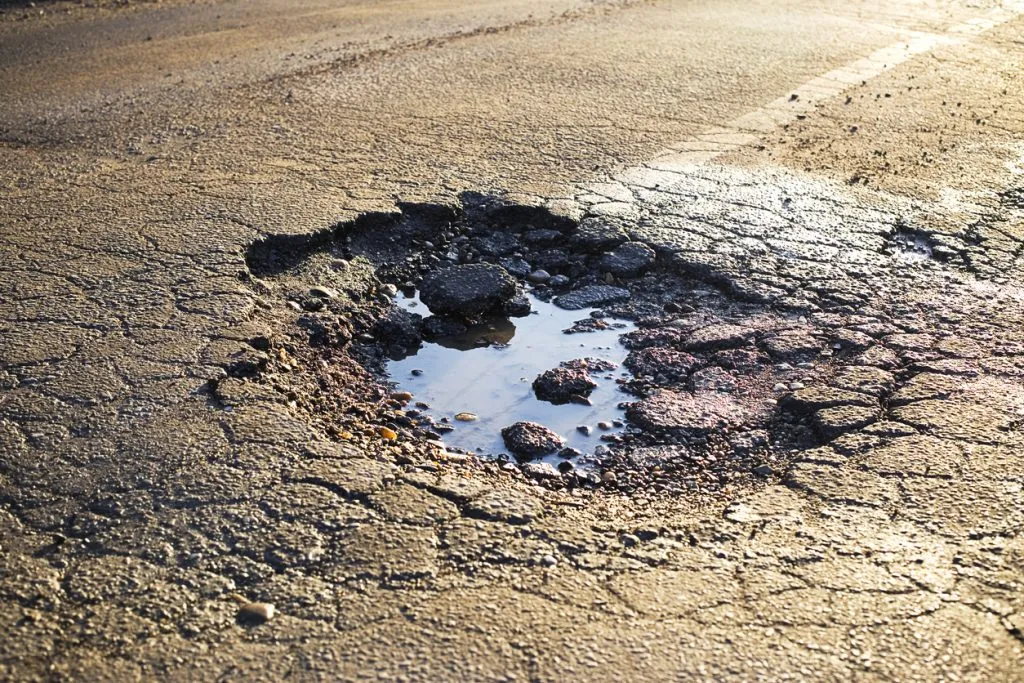
Anyone whose eyesight is good enough for driving can’t fail to notice the huge number of potholes on our roads. These get worse during cold weather. That’s because cracks and imperfections in the road surface allow water in. When the temperature drops, this freezes and expands. As a result, the potholes we’re all so familiar with are created.
Is it just the roads?
It’s easy to say potholes are entirely to blame. Or that speed bumps play a part by making suspension work harder. This isn’t strictly the case. Of course, passenger cars are built to put up with a degree of abuse. But they’re designed primarily for roads with sealed surfaces and not the sort of terrain more suited to tanks.
The cars themselves play a part too. Over the years, motor makers have been under pressure to give cars ever more equipment while also reducing their weight. As we all want air-conditioning and airbags in cars with lower exhaust emissions, car makers have been cutting overall weight by using lighter materials for various components such as suspension parts. On some cars, the suspension simply isn’t tough enough to cope with the severe abuse that’s thrown at it.
The weather’s role
Our weather conditions are famously unsympathetic towards cars. If cars’ springs are made from metals that corrode they’re coated with plastic. However the repeated compression of springs and bombardment with foreign objects can cause this plastic coating to fail. This enables salt water to get in and the springs to rust and weaken.
How to prevent the problem
Other than avoiding every pothole out there and only driving on dry days in the summer, it’s impossible to prevent your car from suffering. However, when you wash the car, it should help if you direct the water underneath to clean the worst of the winter salt from the springs and other suspension parts.
 Scott Wilson is vehicle and customer data insight manager for Green Flag
More from Motoring news and advice
View more
Motoring news and advice
Expert advice: why old tyres can be dangerous
Motoring news and advice
Expert advice: why old tyres can be dangerous
Motoring news and advice
Expert advice: why old tyres can be dangerous

Motoring news and advice
Driving holidays on the up: great places to stop on British road trips
Motoring news and advice
Driving holidays on the up: great places to stop on British road trips
Motoring news and advice
Driving holidays on the up: great places to stop on British road trips
Motoring news and advice
Driving holidays on the up: great places to stop on British road trips

Motoring news and advice
Do you play fuel station roulette? All about when the low fuel light is on
Motoring news and advice
Do you play fuel station roulette? All about when the low fuel light is on
Motoring news and advice
Do you play fuel station roulette? All about when the low fuel light is on
Motoring news and advice
Do you play fuel station roulette? All about when the low fuel light is on

Motoring news and advice
Stressed drivers: How to stay calm when behind the wheel of your car
Motoring news and advice
Stressed drivers: How to stay calm when behind the wheel of your car
Motoring news and advice
Stressed drivers: How to stay calm when behind the wheel of your car
Motoring news and advice
Stressed drivers: How to stay calm when behind the wheel of your car

Motoring news and advice
Why should you do a vehicle history check?
Motoring news and advice
Why should you do a vehicle history check?
Motoring news and advice
Why should you do a vehicle history check?
Motoring news and advice
Why should you do a vehicle history check?

Motoring news and advice
How to fit a bike rack to your vehicle
Motoring news and advice
How to fit a bike rack to your vehicle
Motoring news and advice
How to fit a bike rack to your vehicle
Motoring news and advice