Motoring news and advice

Breakdown cover
Shop and services
Help and support
What diesel drivers need to know about their DPF
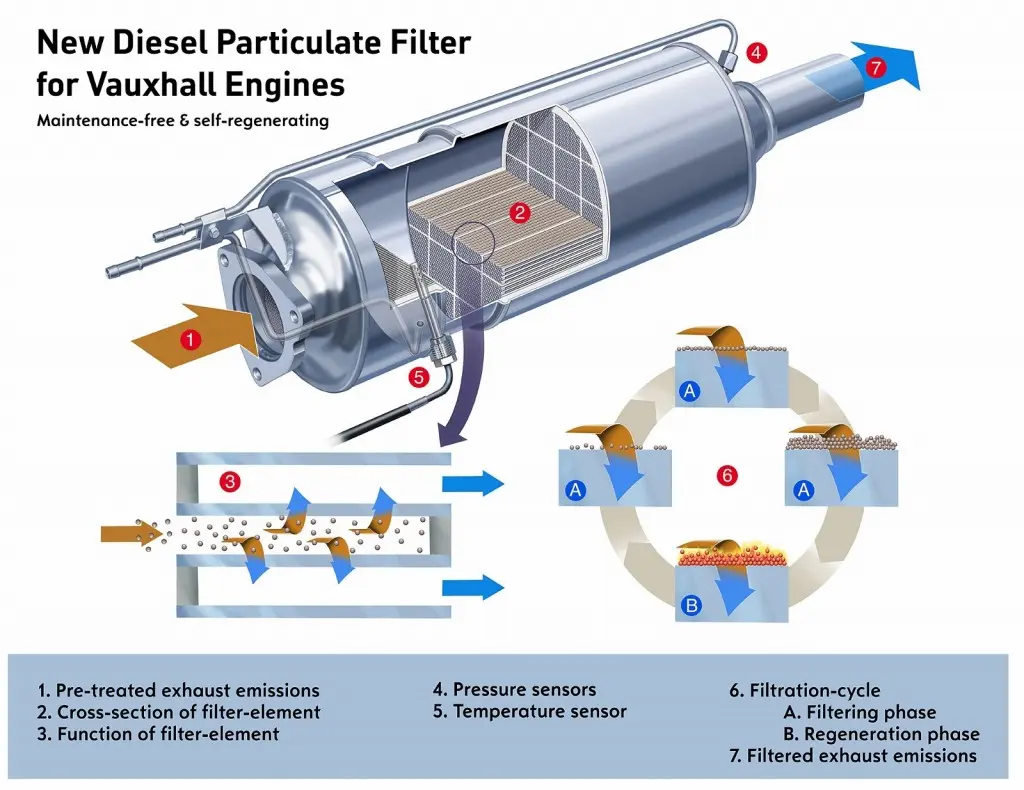
Here's what the DPF looks like (Picture © Vauxhall)
Not many drivers know what a Diesel Particulate Filter (DPF) is – until it costs them serious money. And replacing one can cost £1000 or more. Green Flag attends a lot of cars that have broken down with DPF problems and they are caused by one primary factor: the DPF is clogged with soot because the driver has ignored the warning lamp. Here’s everything you need to know about the DPF dilemma.
What is a DPF?
The Diesel Particulate Filter is in the exhaust system of all diesel-powered cars sold new since 2009. It is a vital component that is designed to enable cars to pass increasingly tough emissions legislation. The DPF’s job is to trap the particles that are caused by the compression-ignition combustion process and thereby prevent harmful smoke from being pumped into the atmosphere.
How does it work?
Like any filter, the DPF will gradually get clogged with the soot that it traps. However, the car is designed to clean it by heating this residue up, turning it to ash and expelling it. This happens about every 300 miles, either when you travel at motorway speed, or because the Engine Control Unit initiates what’s known as regeneration by raising exhaust temperatures artificially.
Why it goes wrong
 In stop/start traffic, or on short journeys, a regeneration may not get time to complete. This will cause the DPF to block partially and an orange light (left) will come on in the instrument cluster. Ignore the light and continue driving slowly or in traffic and eventually the engine will lose power and stop. This will prompt a trip to the garage and things will get expensive. And I mean really expensive: if the car needs a new DPF, we’re talking more than £1000.
What to do if you see the warning light
When the DPF warning lamp comes on (check your handbook to see exactly what the one on your diesel looks like) it's time to take the vehicle on a longer run, preferably on a faster road such as a dual carriageway or motorway. Driving at 40mph or more for 10 minutes should prompt the DPF to go into ‘regeneration’ mode and burn off soot which will clear any blockage.
How to prevent problems in the first place
Before you buy a car, consider the kind of mileage you do. If most of your miles involve short journeys or sitting in stop-start traffic where the car never really gets going, plump for petrol rather than diesel. There’s another good reason for this. Diesel cars are generally more expensive than petrol and because diesel is pricier at the pumps too, you don’t see any payback from a diesel car’s improved economy unless you do a healthy annual mileage.
Why not get rid of the DPF?
One answer to problems with the DPF might be to remove it altogether. But DPFs are installed for a very good reason – they cut pollution – so it’s not a very responsible solution. Also, from February 2014, any car that’s had its DPF removed is an MOT failure. Despite this, there are still companies advertising on the internet to remove DPFs and do the associated re-programming of engine software. Don’t be tempted: it may well invalidate your warranty as well as making your car dirtier and potentially unroadworthy.
 Nick Reid is a fellow of the Institute of the Motor Industry and head of transformation at Green Flag
More from Motoring news and advice
View more
Motoring news and advice
Expert advice: why old tyres can be dangerous
Motoring news and advice
Expert advice: why old tyres can be dangerous
Motoring news and advice
Expert advice: why old tyres can be dangerous
Motoring news and advice
Driving holidays on the up: great places to stop on British road trips
Motoring news and advice
Driving holidays on the up: great places to stop on British road trips
Motoring news and advice
Driving holidays on the up: great places to stop on British road trips
Motoring news and advice
Driving holidays on the up: great places to stop on British road trips
Motoring news and advice
Do you play fuel station roulette? All about when the low fuel light is on
Motoring news and advice
Do you play fuel station roulette? All about when the low fuel light is on
Motoring news and advice
Do you play fuel station roulette? All about when the low fuel light is on
Motoring news and advice
Do you play fuel station roulette? All about when the low fuel light is on

Motoring news and advice
Stressed drivers: How to stay calm when behind the wheel of your car
Motoring news and advice
Stressed drivers: How to stay calm when behind the wheel of your car
Motoring news and advice
Stressed drivers: How to stay calm when behind the wheel of your car
Motoring news and advice
Stressed drivers: How to stay calm when behind the wheel of your car

Motoring news and advice
Why should you do a vehicle history check?
Motoring news and advice
Why should you do a vehicle history check?
Motoring news and advice
Why should you do a vehicle history check?
Motoring news and advice
Why should you do a vehicle history check?

Motoring news and advice
How to fit a bike rack to your vehicle
Motoring news and advice
How to fit a bike rack to your vehicle
Motoring news and advice
How to fit a bike rack to your vehicle
Motoring news and advice